
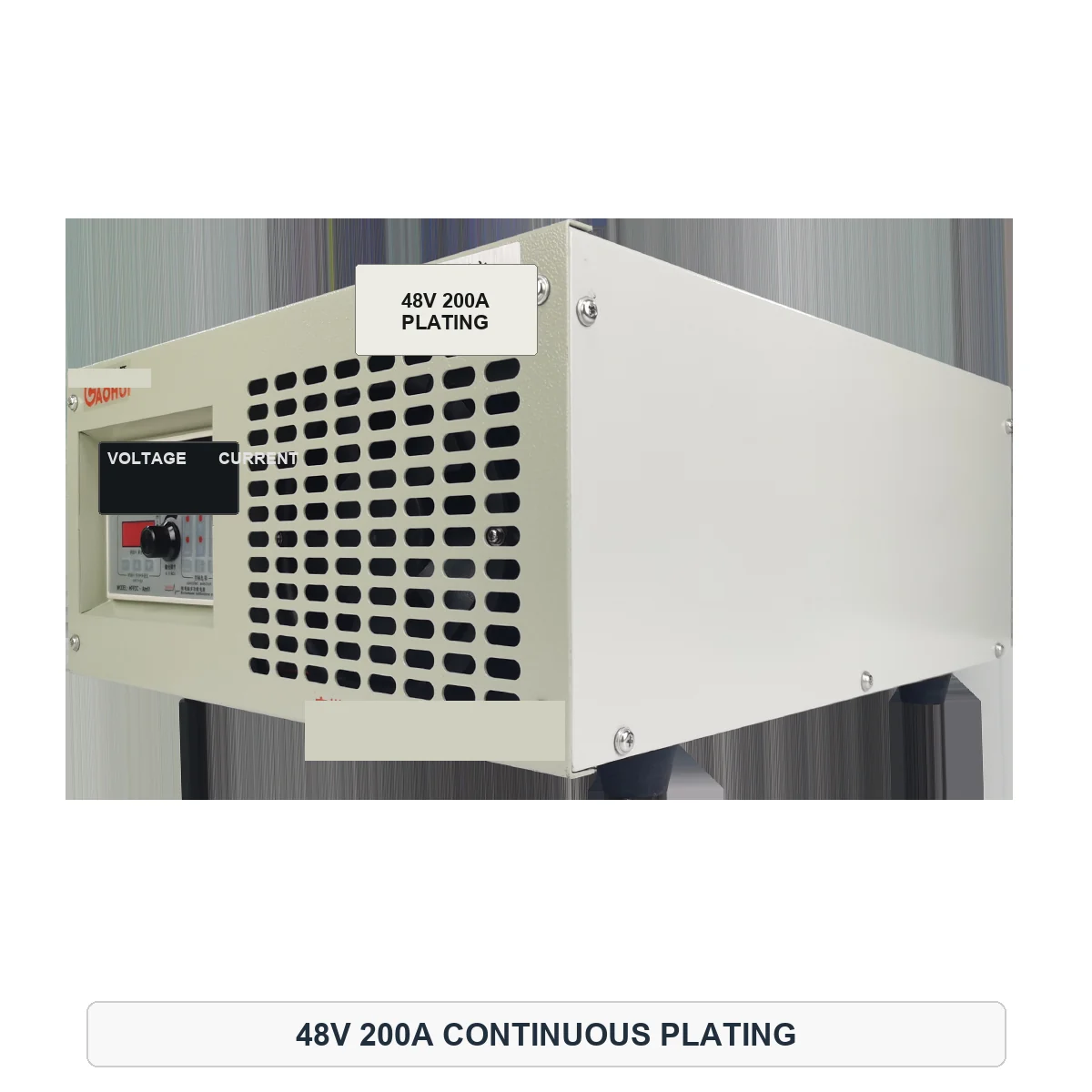
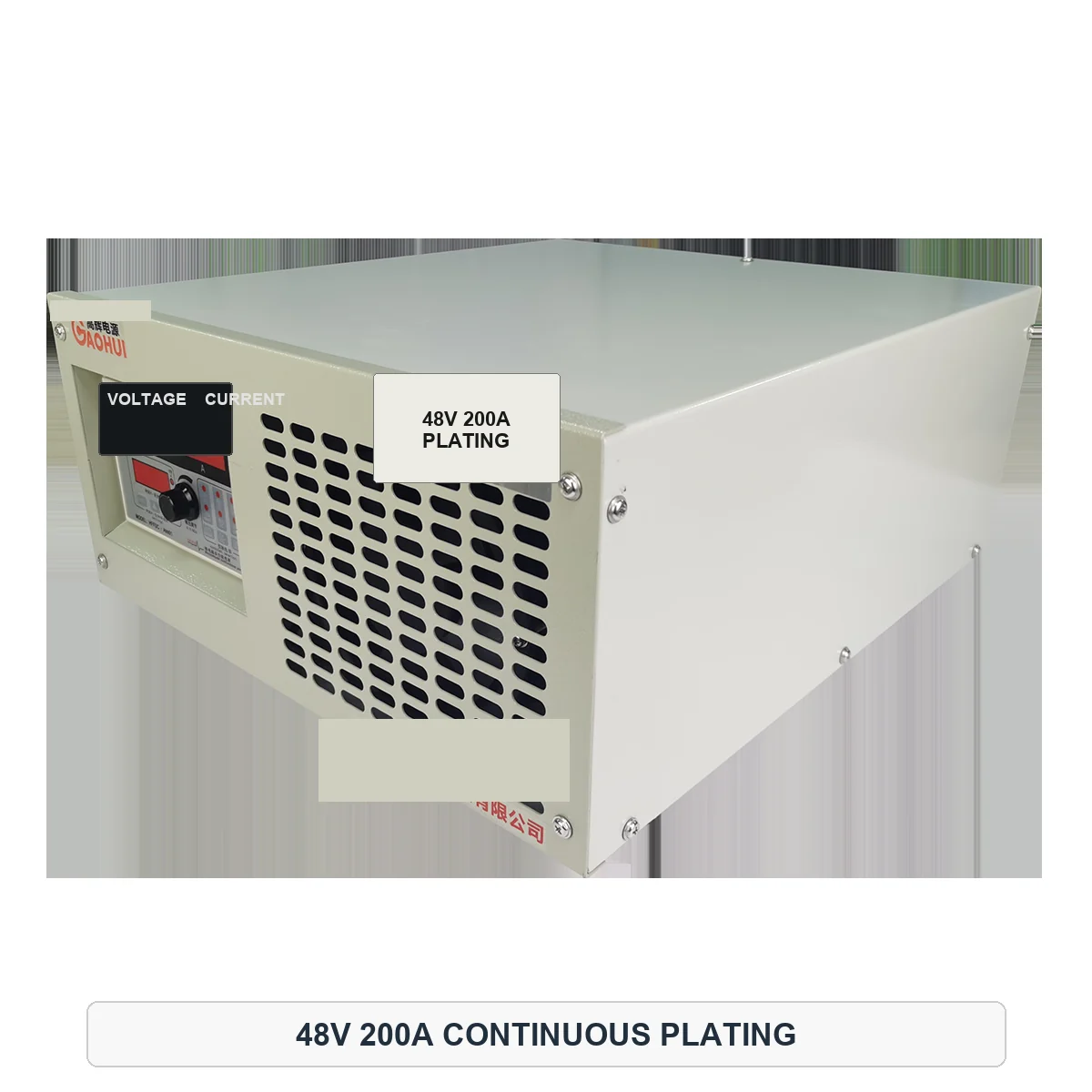
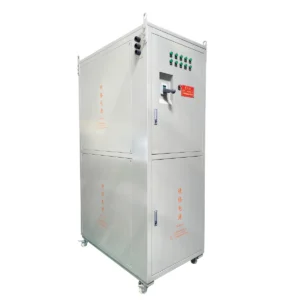
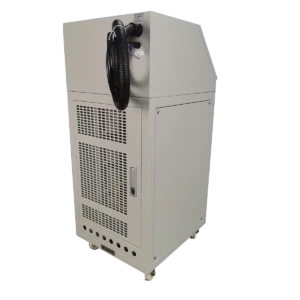
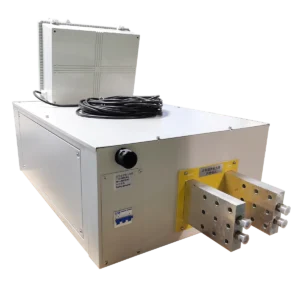
The 48V 200A Continuous Plating DC Power Supply delivers adjustable direct current for strip, wire, terminal and reel-to-reel plating equipment. Its 9.6 kW output, compact air-cooled cabinet and intelligent control panel make it suitable for a production line that needs a controlled DC source close to the plating section.
How the power supply supports continuous plating
In a continuous line, the material moves through one or more energized zones rather than remaining in a stationary batch. The current must follow the plated width, active contact length, line speed and required current density. Stable adjustment helps the operator maintain repeatable electrical conditions as production speed or product width changes, supporting more consistent deposit thickness and surface appearance when the bath, contacts and anode arrangement are correctly maintained.
The 48V ceiling provides additional voltage capability for installations with longer conductor paths, several contact points or higher loaded voltage. It does not force the line to operate at 48V; the working point is adjusted to suit the actual bath and product.
48V 200A output and cabinet specifications
| Rated DC output | 48V, 200A |
|---|---|
| Output power | 9.6 kW |
| Output control | Adjustable DC with constant-current and constant-voltage operation |
| Cooling | Air cooled |
| Control interface | Intelligent control panel |
| Cabinet size | W450 × D500 × H230 mm |
| Approximate weight | 28 kg |
| Typical AC input | Configured for the destination power supply and site standard |
Applications on automatic plating lines
- Reel-to-reel plating of terminals, connectors and stamped strip
- Continuous plating of wire, narrow strip and metal profiles
- Selective plating lines with a defined energized length
- OEM machines that coordinate rectifier output with line controls
Continuous plating describes the production method, not the deposited metal. Copper, nickel, tin, zinc, gold and other processes may use different current densities, bath voltages and control strategies. The rectifier should therefore be matched to both the line arrangement and the actual plating chemistry.
Simple sizing guide for a continuous line
| Item | What determines it |
|---|---|
| Required current | Plated width or area, active contact length, target current density and line speed |
| Required voltage | Loaded bath voltage, contact condition, cable or busbar length and the number of energized sections |
| Number of outputs | Single zone, several independently adjusted zones or multiple plating tanks |
| Control method | Local adjustment, remote station, PLC commands or line-speed coordination |
Common enquiry points include 12V 100A for small equipment, 12V 500A for higher-current low-voltage lines, 24V 500A for a wider operating window, and 48V 200A where the installation requires more voltage capability. These ratings are available as configured products rather than a restriction on the custom range.
Controls and customization
Output voltage and current can be configured from 1–1000V and 1–100,000A for suitable industrial AC-DC applications. Available options include local or remote control, PLC or RS485 communication, recipe and timer functions, ampere-hour control, alarm outputs, multi-channel systems and terminal positioning. Pulse or polarity-reversing output can also be evaluated when the plating process specifically requires it.
Information for a practical quotation
Send the plating metal and bath type, material width, active plating length, line speed, target current density, normal loaded voltage, number of zones and preferred control interface. This allows the electrical output and connection layout to be matched to the machine.
Explore more electroplating rectifiers, compare the broader industrial rectifier range, or contact us for a continuous plating power supply quotation.
Reviews
There are no reviews yet.